 Add to Chrome
 Add to Firefox
 Add to Edge
Correctness-Optimized Residual Activation Lens (CORAL): Transferrable and Calibration-Aware Inference-Time Steering
Feb 05, 2026
Large language models (LLMs) exhibit persistent miscalibration, especially after instruction tuning and preference alignment. Modified training objectives can improve calibration, but retraining is expensive. Inference-time steering offers a lightweight alternative, yet most existing methods optimize proxies for correctness rather than correctness itself. We introduce CORAL (Correctness-Optimized Residual Activation Lens), a regularized inference-time steering method that captures distributed correctness signals from model internal activations using weight-decay MLP probes. We evaluate CORAL across three 7B-parameter models and find that it consistently improves accuracy by 10\% and expected calibration error (ECE) by 50\% on average. We additionally demonstrate that these gains transfer without retraining to the complete published test sets of four held-out benchmarks (ARC-Challenge, HellaSwag, Math-MC, OpenBookQA), averaging 14\% accuracy improvements and 49\% ECE improvements. Our results support the hypothesis that distributed information in model internals can be extracted using regularized probes when individual neurons are insufficient. CORAL thus provides a compute-efficient, transferable, and calibration-aware approach to improve MCQA performance during inference.

Real-Time Deadlines Reveal Temporal Awareness Failures in LLM Strategic Dialogues
Jan 19, 2026Large Language Models (LLMs) generate text token-by-token in discrete time, yet real-world communication, from therapy sessions to business negotiations, critically depends on continuous time constraints. Current LLM architectures and evaluation protocols rarely test for temporal awareness under real-time deadlines. We use simulated negotiations between paired agents under strict deadlines to investigate how LLMs adjust their behavior in time-sensitive settings. In a control condition, agents know only the global time limit. In a time-aware condition, they receive remaining-time updates at each turn. Deal closure rates are substantially higher (32\% vs. 4\% for GPT-5.1) and offer acceptances are sixfold higher in the time-aware condition than in the control, suggesting LLMs struggle to internally track elapsed time. However, the same LLMs achieve near-perfect deal closure rates ($\geq$95\%) under turn-based limits, revealing the failure is in temporal tracking rather than strategic reasoning. These effects replicate across negotiation scenarios and models, illustrating a systematic lack of LLM time awareness that will constrain LLM deployment in many time-sensitive applications.
A Concise Agent is Less Expert: Revealing Side Effects of Using Style Features on Conversational Agents
Jan 15, 2026Style features such as friendly, helpful, or concise are widely used in prompts to steer the behavior of Large Language Model (LLM) conversational agents, yet their unintended side effects remain poorly understood. In this work, we present the first systematic study of cross-feature stylistic side effects. We conduct a comprehensive survey of 127 conversational agent papers from ACL Anthology and identify 12 frequently used style features. Using controlled, synthetic dialogues across task-oriented and open domain settings, we quantify how prompting for one style feature causally affects others via a pairwise LLM as a Judge evaluation framework. Our results reveal consistent and structured side effects, such as prompting for conciseness significantly reduces perceived expertise. They demonstrate that style features are deeply entangled rather than orthogonal. To support future research, we introduce CASSE (Conversational Agent Stylistic Side Effects), a dataset capturing these complex interactions. We further evaluate prompt based and activation steering based mitigation strategies and find that while they can partially restore suppressed traits, they often degrade the primary intended style. These findings challenge the assumption of faithful style control in LLMs and highlight the need for multi-objective and more principled approaches to safe, targeted stylistic steering in conversational agents.
T-FIX: Text-Based Explanations with Features Interpretable to eXperts
Nov 06, 2025As LLMs are deployed in knowledge-intensive settings (e.g., surgery, astronomy, therapy), users expect not just answers, but also meaningful explanations for those answers. In these settings, users are often domain experts (e.g., doctors, astrophysicists, psychologists) who require explanations that reflect expert-level reasoning. However, current evaluation schemes primarily emphasize plausibility or internal faithfulness of the explanation, which fail to capture whether the content of the explanation truly aligns with expert intuition. We formalize expert alignment as a criterion for evaluating explanations with T-FIX, a benchmark spanning seven knowledge-intensive domains. In collaboration with domain experts, we develop novel metrics to measure the alignment of LLM explanations with expert judgment.
Herd Behavior: Investigating Peer Influence in LLM-based Multi-Agent Systems
May 27, 2025Recent advancements in Large Language Models (LLMs) have enabled the emergence of multi-agent systems where LLMs interact, collaborate, and make decisions in shared environments. While individual model behavior has been extensively studied, the dynamics of peer influence in such systems remain underexplored. In this paper, we investigate herd behavior, the tendency of agents to align their outputs with those of their peers, within LLM-based multi-agent interactions. We present a series of controlled experiments that reveal how herd behaviors are shaped by multiple factors. First, we show that the gap between self-confidence and perceived confidence in peers significantly impacts an agent's likelihood to conform. Second, we find that the format in which peer information is presented plays a critical role in modulating the strength of herd behavior. Finally, we demonstrate that the degree of herd behavior can be systematically controlled, and that appropriately calibrated herd tendencies can enhance collaborative outcomes. These findings offer new insights into the social dynamics of LLM-based systems and open pathways for designing more effective and adaptive multi-agent collaboration frameworks.
ZeroTuning: Unlocking the Initial Token's Power to Enhance Large Language Models Without Training
May 16, 2025Recently, training-free methods for improving large language models (LLMs) have attracted growing interest, with token-level attention tuning emerging as a promising and interpretable direction. However, existing methods typically rely on auxiliary mechanisms to identify important or irrelevant task-specific tokens, introducing potential bias and limiting applicability. In this paper, we uncover a surprising and elegant alternative: the semantically empty initial token is a powerful and underexplored control point for optimizing model behavior. Through theoretical analysis, we show that tuning the initial token's attention sharpens or flattens the attention distribution over subsequent tokens, and its role as an attention sink amplifies this effect. Empirically, we find that: (1) tuning its attention improves LLM performance more effectively than tuning other task-specific tokens; (2) the effect follows a consistent trend across layers, with earlier layers having greater impact, but varies across attention heads, with different heads showing distinct preferences in how they attend to this token. Based on these findings, we propose ZeroTuning, a training-free approach that improves LLM performance by applying head-specific attention adjustments to this special token. Despite tuning only one token, ZeroTuning achieves higher performance on text classification, multiple-choice, and multi-turn conversation tasks across models such as Llama, Qwen, and DeepSeek. For example, ZeroTuning improves Llama-3.1-8B by 11.71% on classification, 2.64% on QA tasks, and raises its multi-turn score from 7.804 to 7.966. The method is also robust to limited resources, few-shot settings, long contexts, quantization, decoding strategies, and prompt variations. Our work sheds light on a previously overlooked control point in LLMs, offering new insights into both inference-time tuning and model interpretability.
Know Me, Respond to Me: Benchmarking LLMs for Dynamic User Profiling and Personalized Responses at Scale
Apr 19, 2025Large Language Models (LLMs) have emerged as personalized assistants for users across a wide range of tasks -- from offering writing support to delivering tailored recommendations or consultations. Over time, the interaction history between a user and an LLM can provide extensive information about an individual's traits and preferences. However, open questions remain on how well LLMs today can effectively leverage such history to (1) internalize the user's inherent traits and preferences, (2) track how the user profiling and preferences evolve over time, and (3) generate personalized responses accordingly in new scenarios. In this work, we introduce the PERSONAMEM benchmark. PERSONAMEM features curated user profiles with over 180 simulated user-LLM interaction histories, each containing up to 60 sessions of multi-turn conversations across 15 real-world tasks that require personalization. Given an in-situ user query, i.e. query issued by the user from the first-person perspective, we evaluate LLM chatbots' ability to identify the most suitable response according to the current state of the user's profile. We observe that current LLMs still struggle to recognize the dynamic evolution in users' profiles over time through direct prompting approaches. As a consequence, LLMs often fail to deliver responses that align with users' current situations and preferences, with frontier models such as GPT-4.1, o4-mini, GPT-4.5, o1, or Gemini-2.0 achieving only around 50% overall accuracy, suggesting room for improvement. We hope that PERSONAMEM, along with the user profile and conversation simulation pipeline, can facilitate future research in the development of truly user-aware chatbots. Code and data are available at github.com/bowen-upenn/PersonaMem.
PsychAdapter: Adapting LLM Transformers to Reflect Traits, Personality and Mental Health
Dec 22, 2024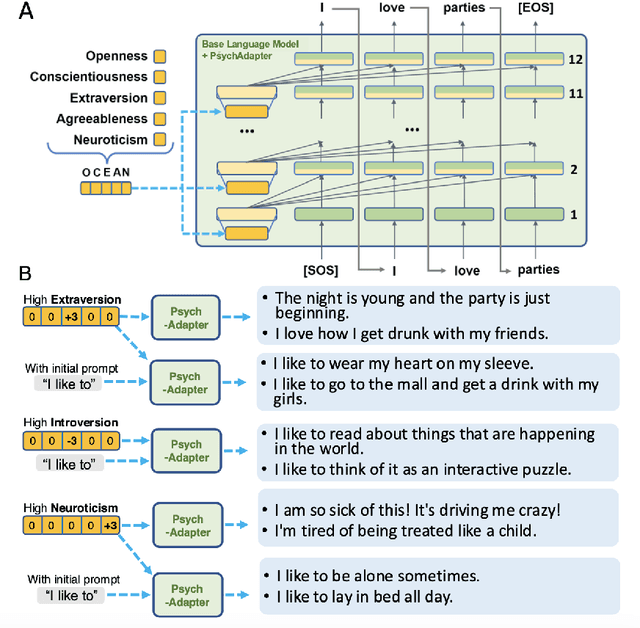
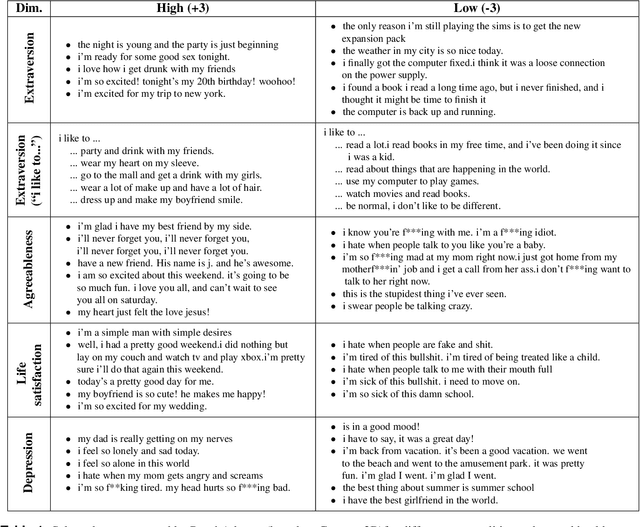
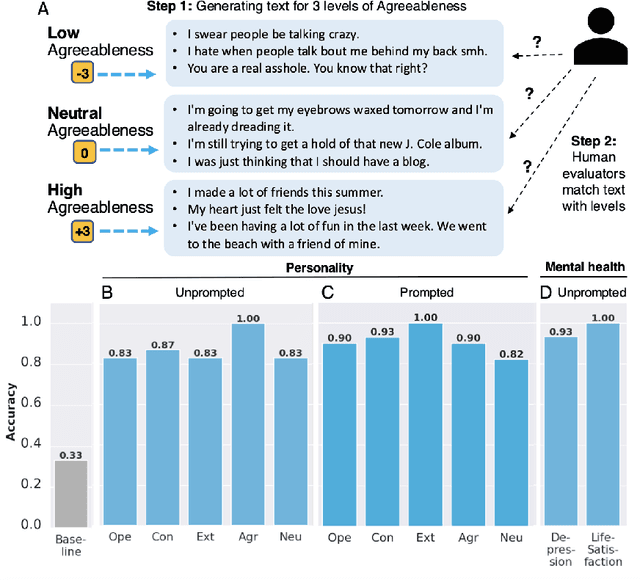

Artificial intelligence-based language generators are now a part of most people's lives. However, by default, they tend to generate "average" language without reflecting the ways in which people differ. Here, we propose a lightweight modification to the standard language model transformer architecture - "PsychAdapter" - that uses empirically derived trait-language patterns to generate natural language for specified personality, demographic, and mental health characteristics (with or without prompting). We applied PsychAdapters to modify OpenAI's GPT-2, Google's Gemma, and Meta's Llama 3 and found generated text to reflect the desired traits. For example, expert raters evaluated PsychAdapter's generated text output and found it matched intended trait levels with 87.3% average accuracy for Big Five personalities, and 96.7% for depression and life satisfaction. PsychAdapter is a novel method to introduce psychological behavior patterns into language models at the foundation level, independent of prompting, by influencing every transformer layer. This approach can create chatbots with specific personality profiles, clinical training tools that mirror language associated with psychological conditionals, and machine translations that match an authors reading or education level without taking up LLM context windows. PsychAdapter also allows for the exploration psychological constructs through natural language expression, extending the natural language processing toolkit to study human psychology.
The Illusion of Empathy: How AI Chatbots Shape Conversation Perception
Nov 19, 2024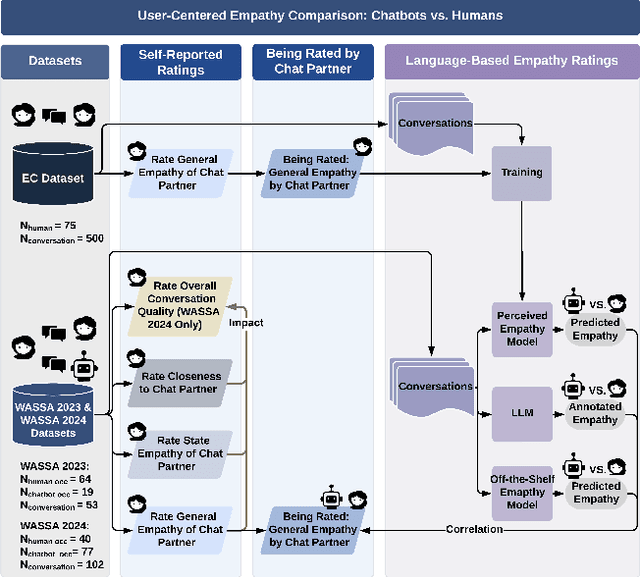


As AI chatbots become more human-like by incorporating empathy, understanding user-centered perceptions of chatbot empathy and its impact on conversation quality remains essential yet under-explored. This study examines how chatbot identity and perceived empathy influence users' overall conversation experience. Analyzing 155 conversations from two datasets, we found that while GPT-based chatbots were rated significantly higher in conversational quality, they were consistently perceived as less empathetic than human conversational partners. Empathy ratings from GPT-4o annotations aligned with users' ratings, reinforcing the perception of lower empathy in chatbots. In contrast, 3 out of 5 empathy models trained on human-human conversations detected no significant differences in empathy language between chatbots and humans. Our findings underscore the critical role of perceived empathy in shaping conversation quality, revealing that achieving high-quality human-AI interactions requires more than simply embedding empathetic language; it necessitates addressing the nuanced ways users interpret and experience empathy in conversations with chatbots.
The FIX Benchmark: Extracting Features Interpretable to eXperts
Sep 20, 2024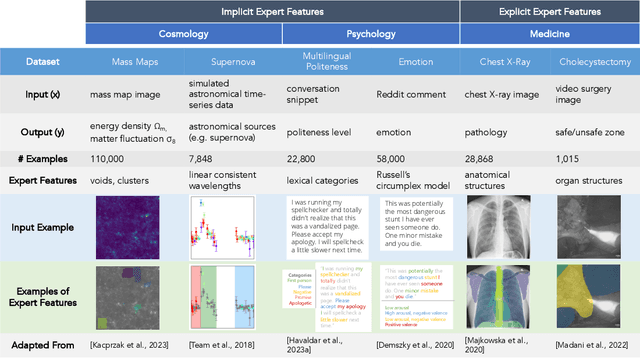

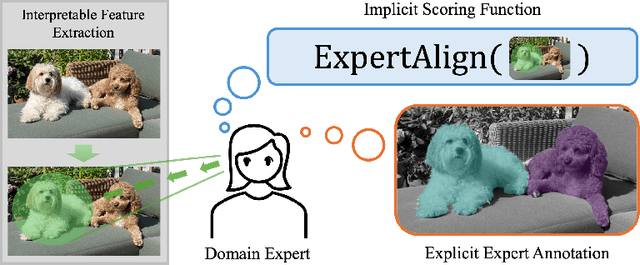

Feature-based methods are commonly used to explain model predictions, but these methods often implicitly assume that interpretable features are readily available. However, this is often not the case for high-dimensional data, and it can be hard even for domain experts to mathematically specify which features are important. Can we instead automatically extract collections or groups of features that are aligned with expert knowledge? To address this gap, we present FIX (Features Interpretable to eXperts), a benchmark for measuring how well a collection of features aligns with expert knowledge. In collaboration with domain experts, we have developed feature interpretability objectives across diverse real-world settings and unified them into a single framework that is the FIX benchmark. We find that popular feature-based explanation methods have poor alignment with expert-specified knowledge, highlighting the need for new methods that can better identify features interpretable to experts.